
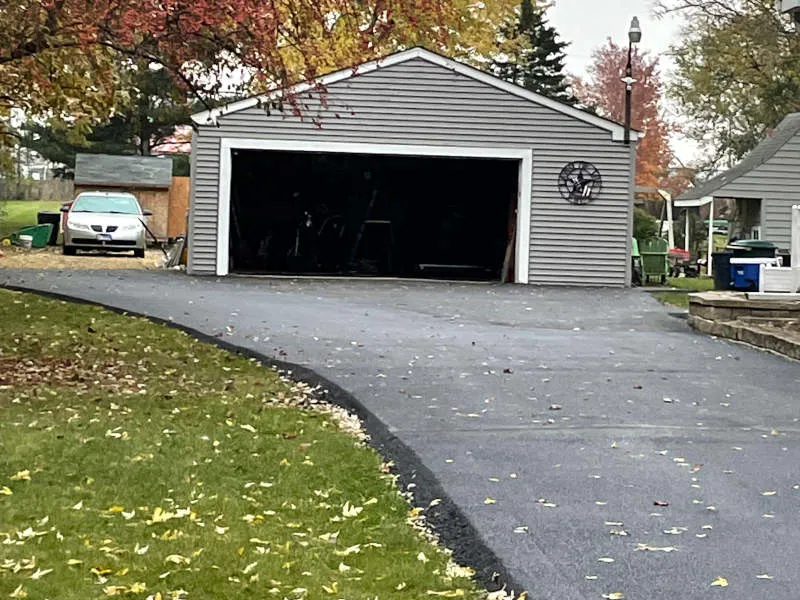
Seal every crack wider than an eighth of an inch before Aurora’s first hard freeze, and finish any sealcoating while daytime temperatures still hold above 50°F for a full 48 hours. Crack sealing stays practical into late October and often early November. The sealcoating window usually closes in mid-October.
Those two deadlines are different, and mixing them up is the single most expensive mistake Aurora homeowners make each fall. Sealcoat applied too late peels off by March. Cracks left open through winter turn into potholes by spring.
Shamblin Paving has been maintaining asphalt across Aurora and the western Chicago suburbs for more than 15 years. Here is the timing guidance our crews use for driveway sealcoating and crack repair every fall, backed by local climate data and manufacturer specifications.
Why Aurora Winters Are Hard on Asphalt Driveways
Aurora pavement fails from repeated freezing and thawing, not from raw cold. Water seeps into a crack, freezes, expands roughly nine percent, and pries the crack wider. Then it thaws, more water enters, and the cycle repeats.
Aurora sits along the Fox River at about 690 feet of elevation, spreading across Kane, DuPage, Kendall, and Will counties. The city averages 29 inches of snow and nearly 38 inches of total precipitation a year, and it spends months hovering right around the freezing mark. National Weather Service data for the Chicago metropolitan area, as reported by regional pavement analysts, puts the region at roughly 80 to 100 freeze-thaw transitions per winter season.
That oscillation matters more than absolute temperature. Minneapolis is colder but often stays frozen for weeks at a stretch, producing fewer full cycles. Aurora swings back and forth across 32°F all winter, which is the worst possible pattern for asphalt. The Federal Highway Administration estimates that close to 30 percent of pavement maintenance costs in cold regions trace back to frost-related damage.
| Month | Avg High | Avg Low | Avg Snow | What It Means for Your Driveway |
|---|---|---|---|---|
| September | 75°F | 55°F | 0 in | Prime sealcoating and crack sealing conditions |
| October | 62°F | 43°F | 0 in | Sealcoating window closing, crack sealing ideal |
| November | 48°F | 33°F | 1 in | Too cold to sealcoat, crack sealing still possible |
| December | 34°F | 20°F | 9 in | Freeze-thaw damage actively underway |
| January | 30°F | 16°F | 8 in | Peak salt exposure and plow contact |
| February | 35°F | 20°F | 7 in | Thaw cycles widen every unsealed crack |
Source: 1991-2020 climate normals for Aurora, IL (US Climate Data, station 60506).
Salt, Plows, and Snowmelt Add a Second Layer of Damage
De-icing chemicals reach your driveway whether or not you apply them yourself. Neighboring North Aurora alone spreads roughly 2,300 tons of salt in an average winter, and the City of Aurora maintains about 1,360 lane miles of roadway with a goal of clearing every street within 12 hours after snowfall stops on accumulations of three inches or less.
Brine and salt slurry get tracked onto residential driveways by tires, then work into open cracks and accelerate binder breakdown. Plow blades and shovels catch any raised edge. If water has nowhere to drain, standing meltwater refreezes overnight, which is why drainage and catch basin condition matters as much on a sloped Aurora driveway as it does on a commercial lot.
Do Asphalt Cracks Need Sealing Before Winter in Aurora, IL?
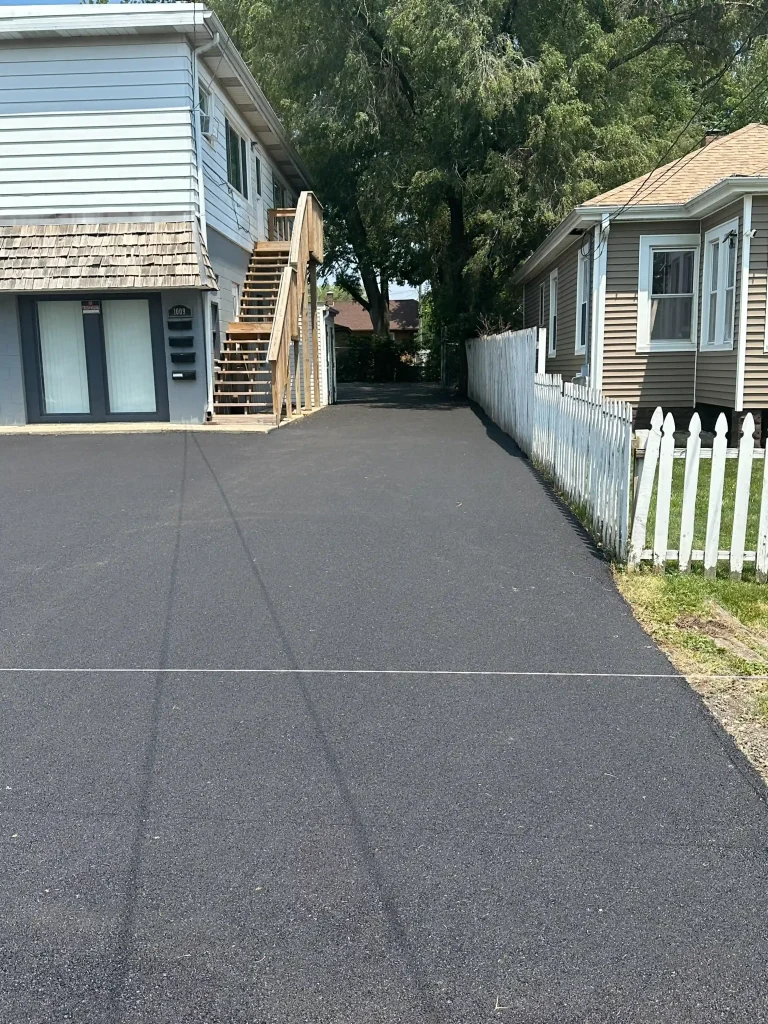
Yes. Sealing cracks before winter is the highest-return maintenance step an Aurora property owner can take, and the data is not close. Research summarized by the Pavement Preservation and Recycling Alliance found that roughly 75 percent of unsealed cracks develop into potholes within three years, compared with about 1 percent of properly sealed cracks.
Crack sealing typically runs $0.50 to $3.00 per linear foot, or roughly $300 to $800 for a standard residential driveway. Compare that to $100 to $300 per pothole repair or $3 to $7 per square foot for full replacement. Long-running studies by the Ministry of Transportation of Ontario concluded that crack sealing extends asphalt service life by two to five years.
The Federal Highway Administration, cited by the Texas A&M Transportation Institute, puts the return even higher: every $1 spent on preventive pavement maintenance saves $6 to $10 in future rehabilitation.
What Happens Inside an Unsealed Crack During an Aurora Winter
- Rain and snowmelt run into the open crack and soak down through the asphalt surface.
- Water reaches the aggregate base and the clay-heavy subgrade common across the Fox Valley.
- Temperatures drop overnight, the trapped water freezes, and it expands about nine percent.
- The expansion lifts and widens the crack, and the saturated base heaves unevenly beneath the surface.
- A thaw arrives, the base settles, and the pavement above is left unsupported. Vehicle weight finishes the job and a pothole appears.
Repeat that sequence 80 or more times between November and March and a hairline crack becomes a structural failure. At that point you are no longer buying sealant, you are buying asphalt patching or a new surface.
Which Cracks Need Sealing and Which Need More
| Crack Width or Type | Correct Treatment | Why |
|---|---|---|
| Under 1/8 inch | Sealcoat in season, monitor | Too narrow to hold sealant reliably |
| 1/8 to 1/2 inch | Hot-pour rubberized crack sealing | Ideal candidate, sealant bonds and stays flexible |
| 1/2 to 1.5 inches | Rout and seal | Routing cuts a reservoir so sealant has depth to grip |
| Over 1.5 inches | Patching or partial-depth repair | Beyond the working limit of most sealant specs |
| Alligator cracking | Full-depth repair or replacement | Signals base failure, not a surface problem |
| Edge crumbling | Patching plus drainage correction | Usually caused by water undermining the shoulder |
Professional crews use hot-applied rubberized sealant meeting ASTM D6690 Type II or III, heated to between 380°F and 410°F. That material stays flexible as the crack opens in January cold and closes in July heat, which is exactly what a rigid cold-pour filler from a hardware store cannot do. If the pattern looks more like spiderwebbing than a single line, book a driveway repair assessment instead.
When Is It Too Cold to Sealcoat in Aurora, IL?
It is too cold to sealcoat once temperatures fall below 50°F, and that includes overnight lows. The industry standard calls for at least 50°F and rising at the moment of application, with temperatures staying above 50°F continuously for the next 24 to 48 hours while the coating cures.
Aurora’s October normals show why this matters. Average highs of 62°F look workable, but average lows of 43°F do not. A coating applied on a pleasant 60-degree afternoon that drops into the low 40s that night will not cure. It will look finished, and it will sweep off the pavement in spring.
The 50-Degree Rule Explained in Plain Terms
Sealcoat is a water-based emulsion. Curing happens as that water evaporates and the coating knits into a continuous film bonded to the asphalt. Below 50°F, evaporation effectively stops, the film never forms, and the remaining water can freeze inside the coating and break the bond outright.
Drying and curing are also not the same thing. A surface can feel dry to the touch within a few hours while the full cure takes weeks of stable warmth. Manufacturers will not warranty sealer applied below their specified temperature range, which is one of the most common sealcoating mistakes homeowners make. The ideal application range is 70°F to 85°F with low humidity and no rain for 24 hours.
The Aurora Sealcoating Calendar
| Timeframe | Sealcoating | Crack Sealing | Notes |
|---|---|---|---|
| May to August | Ideal | Good | Warmest surface temperatures, fastest cure |
| Early September | Ideal | Ideal | Best combined window of the year |
| Late September | Good | Ideal | Watch overnight lows and shorter daylight |
| Early October | Marginal | Ideal | Only on a warm, dry forecast run |
| Late October | Closed | Good | Overnight lows routinely below 50°F |
| November | Closed | Marginal | Possible on dry days if pavement reaches 40°F |
| December to March | Closed | Emergency only | Torch-dried cracks, temporary repairs |
Shaded areas change the math. A driveway on the north side of a house, or one screened by mature trees in older neighborhoods near downtown Aurora, can sit five to ten degrees cooler than the reported air temperature and may never dry properly in October. The same principle applies to commercial parking lot sealcoating on properties with large buildings casting long autumn shadows.
Crack Sealing vs Sealcoating: Which Comes First?
Crack sealing always comes first, and it has a longer seasonal window. Sealcoat is a thin surface film that protects against ultraviolet light, oxidation, and minor wear. It cannot bridge a structural crack, and spreading it over open cracks simply hides them.
| Factor | Crack Sealing | Sealcoating |
|---|---|---|
| Purpose | Blocks water from reaching the base | Shields the surface from UV and oxidation |
| Coverage | Individual cracks only | Entire driveway surface |
| Typical cost | $0.50 to $3.00 per linear foot | $0.15 to $0.30 per square foot |
| Minimum temperature | About 40°F pavement temperature | 50°F and rising, held 24 to 48 hours |
| Aurora season end | Late October into November | Mid-October |
| Service interval | Every 1 to 2 years | Every 2 to 3 years |
| Winter urgency | High, do it before the freeze | Low, defer to spring if needed |
Hot-pour sealant can be applied at pavement temperatures as low as 40°F, and experienced crews extend that further by using a heat lance to dry and warm the crack walls before the material goes in. That is why crack sealing remains available weeks after the sealcoating trucks have been winterized.
Your Aurora Winter Driveway Prep Checklist
Work backward from the first hard freeze. The National Weather Service notes that Illinois typically sees its first freeze around the middle of October, with the first hard freeze at 28°F or lower following in late October or the first days of November.
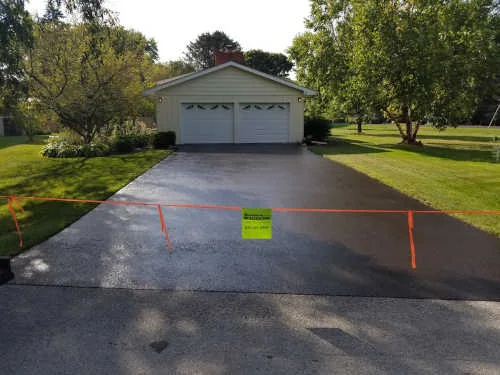
September: The Best Month to Act
- Walk the full driveway and mark every crack wider than 1/8 inch
- Schedule sealcoating now if the surface is due, since September offers the last reliable cure window
- Clear vegetation and debris out of cracks so sealant can bond
- Check that water drains off the surface rather than pooling at low spots
October: The Crack Sealing Priority Month
- Complete all crack sealing while daytime highs remain in the 50s and 60s
- Repair potholes and failed edges before they take on water
- Trim back branches so sun can reach the pavement and speed drying
- Skip sealcoating unless a warm, dry multi-day forecast makes the 48-hour cure realistic
November and Beyond: Protect What You Sealed
- Mark driveway edges before the first plowable snow so blades and snow removal equipment stay on the pavement
- Use calcium chloride or magnesium chloride instead of rock salt where possible, since they are less aggressive on asphalt binder
- Shovel or blow snow off rather than letting it melt and refreeze in place
- Avoid metal-edged shovels and never chip at ice with a spade
What to Do If You Missed the Sealcoating Window
Do not sealcoat anyway. A contractor willing to spray sealer in late November in Aurora is selling you a job that will fail, and you will pay twice: once now and again in spring to strip and redo it.
Seal the cracks instead, which is the treatment that actually protects the pavement structure through winter, then book sealcoating for May or June. If the surface is already past the point where a coating helps, meaning widespread alligator cracking or a base that flexes underfoot, plan for asphalt resurfacing or driveway replacement in the spring paving season instead of spending money on cosmetics.
Owners weighing a full rebuild often ask about material at the same time. Our breakdown of concrete versus asphalt for driveways covers how each performs through Illinois freeze-thaw cycles, and we install concrete driveways as well.
Expert Insight: The Two Deadlines Are Not the Same
“The call we hate getting is in April, from someone who paid for sealcoat in November because the afternoon felt warm. The coating is peeling in sheets and every crack underneath is wider than it was in the fall. Sealing the cracks in October would have cost a fraction and actually protected the driveway.” That is how our estimating team frames the choice to Aurora homeowners every autumn.
Client note: confirm attribution and preferred spokesperson name for this quote before publishing.
The underlying principle is standard pavement preservation practice. Treatments that keep water out of the base deliver the highest return, and surface treatments only pay off when applied under conditions that let them cure.
Serving Aurora and the Fox Valley
Shamblin Paving handles residential paving services and parking lot maintenance across Aurora and the western suburbs, including North Aurora, Montgomery, Oswego, Naperville, Batavia, Sugar Grove, Plainfield, and St. Charles. See the full service area or contact us for a free, no-obligation estimate before the freeze arrives.
Frequently Asked Questions
Do I really need to seal driveway cracks before winter in Aurora?
Yes. Open cracks let water reach the base, where it freezes and expands about nine percent with every cycle. Roughly 75 percent of unsealed cracks become potholes within three years, versus about 1 percent of sealed cracks. At $0.50 to $3.00 per linear foot, sealing is far cheaper than the $3 to $7 per square foot a replacement costs.
When is it too cold to sealcoat a driveway in Aurora, IL?
Below 50°F. Sealer needs at least 50°F and rising when applied, and temperatures must stay above 50°F for 24 to 48 hours while it cures. With average October lows of 43°F in Aurora, the practical cutoff falls in mid-October most years.
Can crack sealing still be done in cold weather?
Yes, within limits. Hot-applied rubberized sealant works at pavement temperatures down to about 40°F, and crews can use a heat lance to dry and warm crack walls on colder days. The crack must be completely dry, which rules out most days after snow arrives.
What is the last month to sealcoat a driveway in Illinois?
October, and only in the first half of the month during a warm, dry stretch. September is the last month that reliably delivers the temperature stability a full cure requires in northern Illinois.
How much does crack sealing cost for an Aurora driveway?
Expect $0.50 to $3.00 per linear foot, which works out to roughly $300 to $800 for a typical residential driveway. Price varies with crack density, whether routing is required, and total footage. Small jobs carry minimum charges that raise the effective per-foot rate.
Should I crack seal and sealcoat during the same visit?
When the calendar allows, yes, and crack sealing goes first. Late in the season, prioritize crack sealing alone and defer the coating to spring. Applying sealcoat over unsealed cracks conceals the problem without solving it, which is why our parking lot repair crews always address cracks before any surface treatment.
Related Shamblin Paving Resources
- Aurora IL Pothole Repair: Causes and Repair Options
- Mistakes Homeowners Make When Sealcoating a Driveway
- Concrete vs Asphalt for Driveways
- Residential Driveway Sealcoating Services
- Asphalt Driveway Installation
- More asphalt maintenance articles on the Shamblin Paving blog
Sources Cited
- US Climate Data, 1991-2020 climate normals for Aurora, Illinois (station 60506)
- National Weather Service, first freeze and hard freeze timing for Illinois
- Federal Highway Administration, pavement preservation cost-benefit guidance, as cited by the Texas A&M Transportation Institute
- Pavement Preservation and Recycling Alliance, crack sealing and pothole formation research
- Ministry of Transportation of Ontario, crack sealing service life studies
- ASTM D6690, standard specification for joint and crack sealants, hot applied
- City of Aurora, Illinois, snow and ice operations summary (approximately 1,360 lane miles)
- Village of North Aurora, Illinois, public works winter salt usage
<script type="application/ld+json">
{
  "@context": "https://schema.org",
  "@graph": [
    {
      "@type": "BlogPosting",
      "@id": "https://shamblinpaving.com/winter-driveway-prep-aurora-il/#article",
      "headline": "How to Prepare Your Driveway for Winter in Aurora, IL: Crack Sealing and Sealcoating Deadlines",
      "description": "Seal driveway cracks before Aurora's freeze-thaw cycle hits and learn the 50-degree sealcoating cutoff. Shamblin Paving's winter prep guide for IL owners.",
      "image": "https://shamblinpaving.com/wp-content/uploads/winter-driveway-prep-aurora.jpg",
      "datePublished": "2026-09-15",
      "dateModified": "2026-09-15",
      "inLanguage": "en-US",
      "wordCount": 2050,
      "author": { "@id": "https://shamblinpaving.com/#organization" },
      "publisher": { "@id": "https://shamblinpaving.com/#organization" },
      "mainEntityOfPage": {
        "@type": "WebPage",
        "@id": "https://shamblinpaving.com/winter-driveway-prep-aurora-il/"
      },
      "about": [
        { "@type": "Thing", "name": "Asphalt crack sealing" },
        { "@type": "Thing", "name": "Driveway sealcoating" },
        { "@type": "Thing", "name": "Freeze-thaw pavement damage" }
      ],
      "mentions": [
        { "@type": "City", "name": "Aurora", "address": { "@type": "PostalAddress", "addressRegion": "IL", "addressCountry": "US" } }
      ]
    },
    {
      "@type": "HomeAndConstructionBusiness",
      "@id": "https://shamblinpaving.com/#organization",
      "name": "Shamblin Paving, LLC",
      "url": "https://shamblinpaving.com/",
      "telephone": "+1-630-361-5542",
      "email": "info@shamblinsealcoat.com",
      "priceRange": "$$",
      "address": {
        "@type": "PostalAddress",
        "streetAddress": "PO Box 134",
        "addressLocality": "Big Rock",
        "addressRegion": "IL",
        "postalCode": "60511",
        "addressCountry": "US"
      },
      "sameAs": [
        "https://www.facebook.com/ShamblinPavingllc/"
      ],
      "areaServed": [
        { "@type": "City", "name": "Aurora" },
        { "@type": "City", "name": "North Aurora" },
        { "@type": "City", "name": "Montgomery" },
        { "@type": "City", "name": "Oswego" },
        { "@type": "City", "name": "Naperville" },
        { "@type": "City", "name": "Batavia" },
        { "@type": "City", "name": "Sugar Grove" },
        { "@type": "City", "name": "Plainfield" },
        { "@type": "City", "name": "St. Charles" }
      ]
    },
    {
      "@type": "Service",
      "@id": "https://shamblinpaving.com/parking-lot-maintenance/crack-sealing/#service",
      "name": "Asphalt Crack Sealing",
      "serviceType": "Asphalt crack sealing and pavement preservation",
      "provider": { "@id": "https://shamblinpaving.com/#organization" },
      "areaServed": { "@type": "City", "name": "Aurora", "address": { "@type": "PostalAddress", "addressRegion": "IL" } }
    },
    {
      "@type": "FAQPage",
      "@id": "https://shamblinpaving.com/winter-driveway-prep-aurora-il/#faq",
      "mainEntity": [
        {
          "@type": "Question",
          "name": "Do I really need to seal driveway cracks before winter in Aurora?",
          "acceptedAnswer": {
            "@type": "Answer",
            "text": "Yes. Open cracks let water reach the base, where it freezes and expands about nine percent with every cycle. Research summarized by the Pavement Preservation and Recycling Alliance found roughly 75 percent of unsealed cracks become potholes within three years, versus about 1 percent of sealed cracks. At $0.50 to $3.00 per linear foot, sealing costs far less than the $3 to $7 per square foot of a full replacement."
          }
        },
        {
          "@type": "Question",
          "name": "When is it too cold to sealcoat a driveway in Aurora, IL?",
          "acceptedAnswer": {
            "@type": "Answer",
            "text": "Below 50 degrees Fahrenheit. Sealer requires at least 50 degrees and rising at application, and temperatures must stay above 50 degrees for 24 to 48 hours while it cures. With average October lows of 43 degrees in Aurora, the practical cutoff falls in mid-October most years."
          }
        },
        {
          "@type": "Question",
          "name": "Can crack sealing still be done in cold weather?",
          "acceptedAnswer": {
            "@type": "Answer",
            "text": "Yes, within limits. Hot-applied rubberized sealant meeting ASTM D6690 works at pavement temperatures down to about 40 degrees Fahrenheit, and crews can use a heat lance to dry and warm crack walls on colder days. The crack must be completely dry, which rules out most days after snow arrives."
          }
        },
        {
          "@type": "Question",
          "name": "What is the last month to sealcoat a driveway in Illinois?",
          "acceptedAnswer": {
            "@type": "Answer",
            "text": "October, and only in the first half of the month during a warm, dry stretch. September is the last month that reliably delivers the temperature stability a full cure requires in northern Illinois."
          }
        },
        {
          "@type": "Question",
          "name": "How much does crack sealing cost for an Aurora driveway?",
          "acceptedAnswer": {
            "@type": "Answer",
            "text": "Expect $0.50 to $3.00 per linear foot, or roughly $300 to $800 for a typical residential driveway. Price varies with crack density, whether routing is required, and total footage. Small jobs carry minimum charges that raise the effective per-foot rate."
          }
        },
        {
          "@type": "Question",
          "name": "Should I crack seal and sealcoat during the same visit?",
          "acceptedAnswer": {
            "@type": "Answer",
            "text": "When the calendar allows, yes, and crack sealing goes first. Late in the season, prioritize crack sealing alone and defer the coating to spring. Applying sealcoat over unsealed cracks conceals the problem without solving it."
          }
        }
      ]
    },
    {
      "@type": "BreadcrumbList",
      "@id": "https://shamblinpaving.com/winter-driveway-prep-aurora-il/#breadcrumb",
      "itemListElement": [
        { "@type": "ListItem", "position": 1, "name": "Home", "item": "https://shamblinpaving.com/" },
        { "@type": "ListItem", "position": 2, "name": "Blog", "item": "https://shamblinpaving.com/blog/" },
        { "@type": "ListItem", "position": 3, "name": "How to Prepare Your Driveway for Winter in Aurora, IL", "item": "https://shamblinpaving.com/winter-driveway-prep-aurora-il/" }
      ]
    }
  ]
}
</script>