Crack Sealing & Filling
REQUEST A QUOTE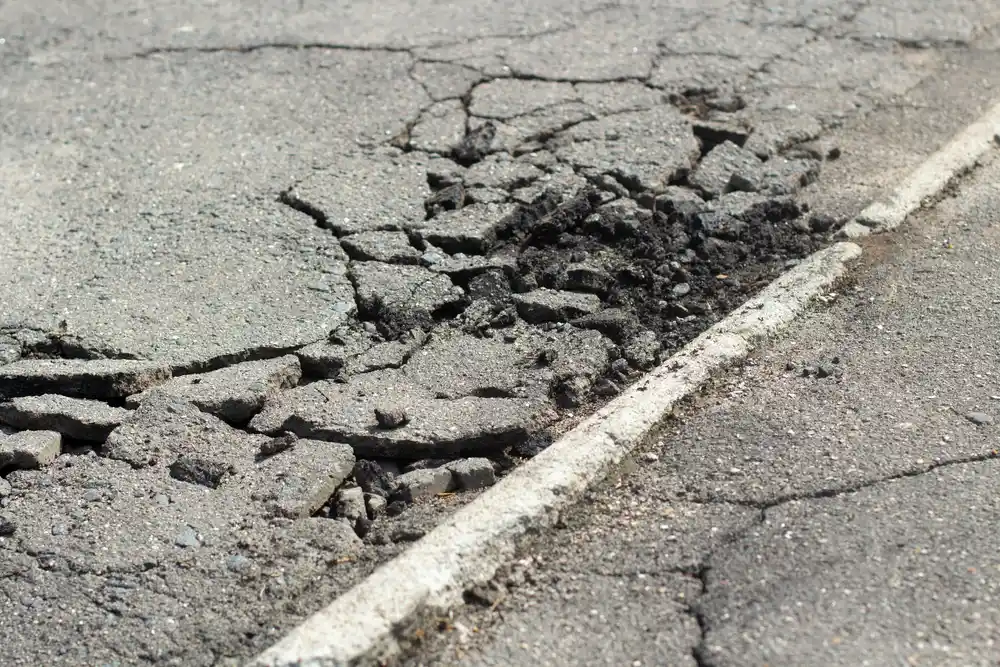
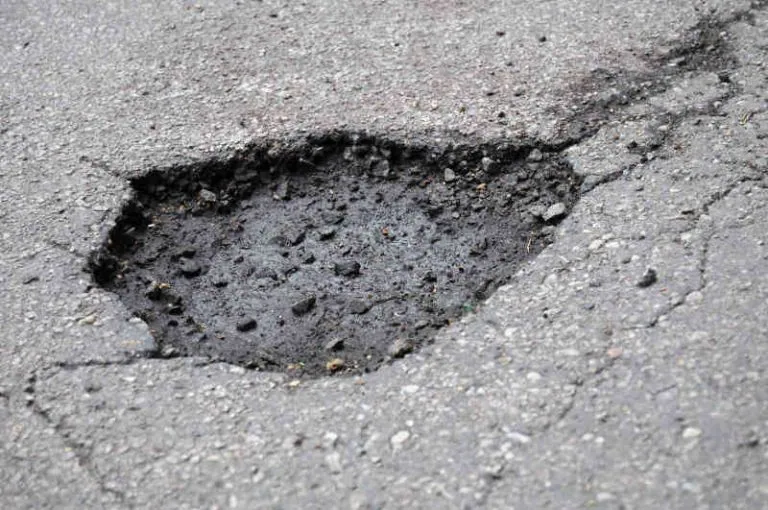
Crack sealing in Aurora, IL is the single most cost-effective thing you can do to extend the life of your parking lot. Every crack in your asphalt is an open door for water, and water is what destroys pavement from the inside out. Once moisture reaches the aggregate base, freeze-thaw cycles do the rest. What started as a hairline crack turns into a pothole, then base failure, then a repair bill ten times what sealing would have cost.
Shamblin Paving has been providing asphalt crack sealing and crack filling services across Aurora, Naperville, Joliet, Plainfield, and the western Chicago suburbs for over 20 years. We use commercial-grade hot-pour rubberized sealant, proper crack routing when the job calls for it, and the right application method for every type of crack. Crack sealing is the foundation of any effective parking lot maintenance plan, and it works best when combined with regular sealcoating to keep water off the surface entirely.
Crack Sealing vs. Crack Filling
These two terms get used interchangeably, but they are different processes designed for different types of cracks. Using the wrong one gives you a repair that does not last.
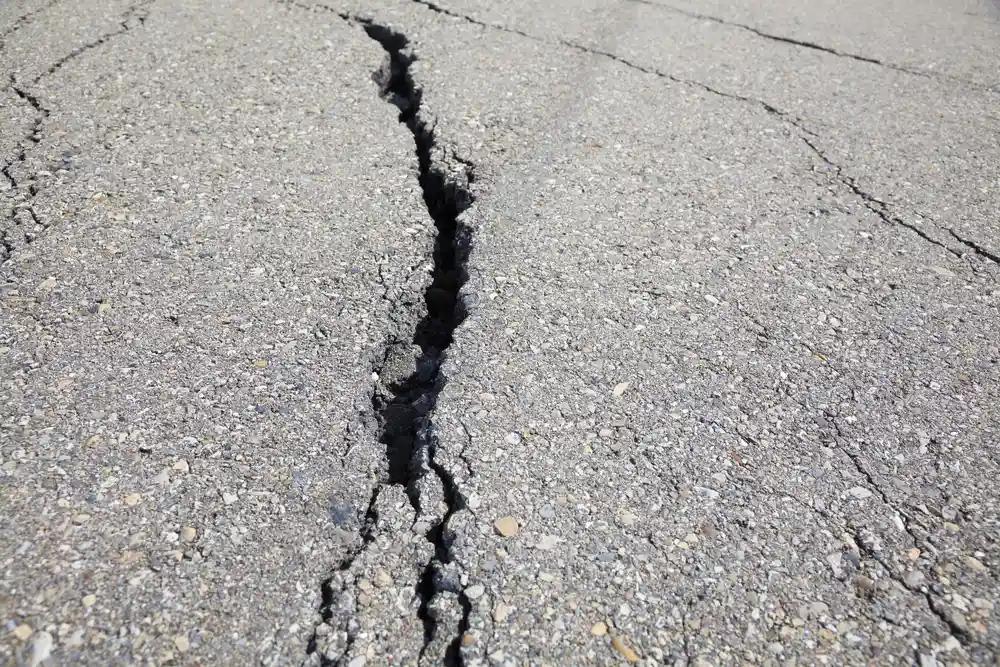
Crack sealing is the more involved and longer-lasting method. It is used on working cracks, meaning cracks that expand and contract with temperature changes. These are typically longitudinal cracks, transverse cracks, and joint cracks that move seasonally. The process involves routing the crack to create a uniform reservoir, cleaning out all debris and moisture with compressed air or heat lance, and filling the routed channel with hot-pour rubberized sealant. The sealant stays flexible after it cures, which allows it to stretch and compress with the crack as temperatures change. A properly sealed crack can stay watertight for 3 to 5 years or more.
Crack filling is used on non-working cracks, meaning cracks that are stable and not actively moving. These include random surface cracks, block cracking from oxidation, and smaller cracks that have not yet penetrated into the base layer. Filling involves cleaning the crack and applying either hot-pour or cold-pour sealant directly into the opening without routing. It seals the crack against water infiltration but does not have the same flexibility or longevity as a routed and sealed joint.
We assess every lot and recommend the right method based on crack type, width, depth, and pavement condition. Most commercial lots in the Aurora area need a combination of both.
Hot-Pour vs. Cold-Pour Sealant
The material you put in the crack matters just as much as the method.
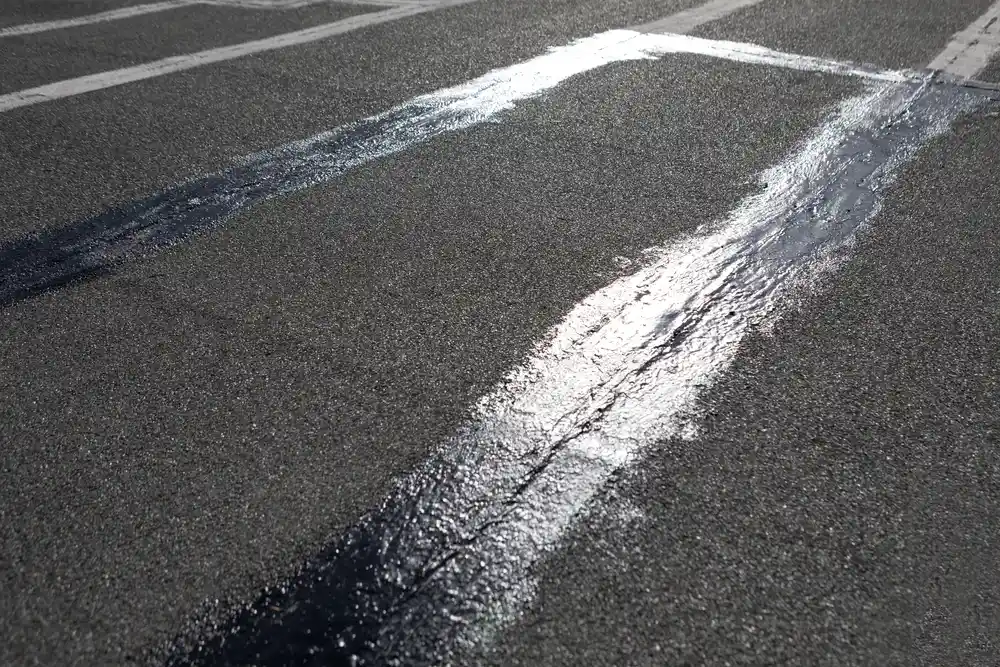
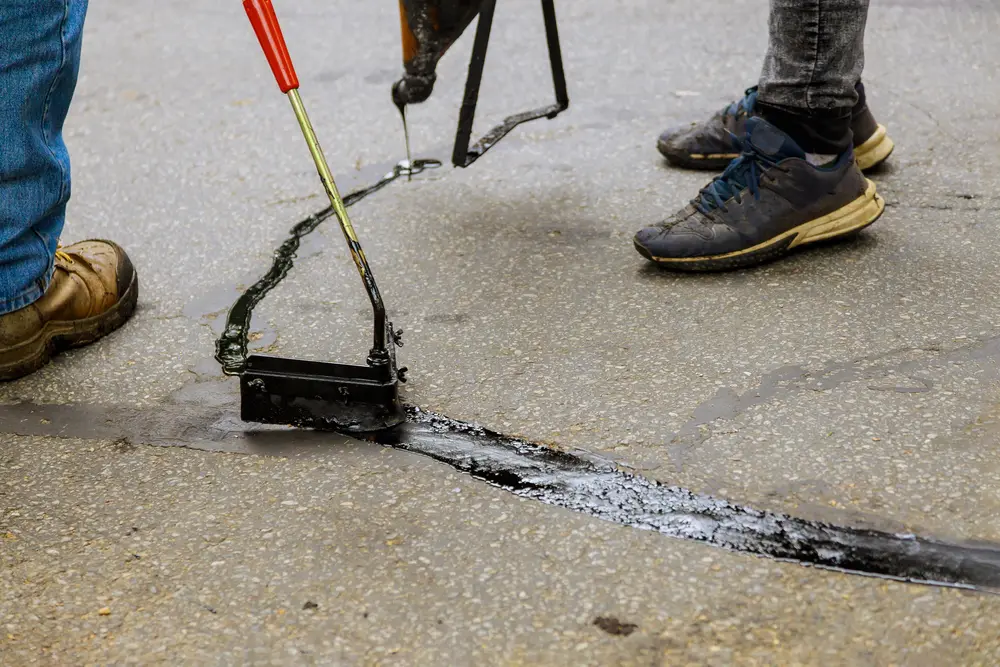
Hot-pour rubberized sealant is the industry standard for commercial crack sealing and crack filling. The material is heated to approximately 380°F in a melter applicator and applied directly into the prepared crack. As it cools, it bonds to the walls of the crack and forms a flexible, waterproof seal that moves with the pavement. Hot-pour sealant meets ASTM D6690 specifications and is rated for commercial traffic loads. This is what we use on the vast majority of our parking lot crack sealing jobs.
Cold-pour sealant is a liquid emulsion product that does not require heating. It is easier to apply and works for minor surface cracks and residential applications, but it does not have the flexibility, adhesion, or durability of hot-pour material. Cold-pour is best suited for thin cosmetic cracks in low-traffic areas or as a temporary measure when hot-pour application is not practical.
For commercial parking lots, hot-pour is always the better investment. It costs more per linear foot to apply, but the seal lasts significantly longer and provides real protection against water infiltration.
Crack Routing
Routing is the step that separates a professional crack sealing job from a band-aid application. A crack router is a machine with a spinning carbide blade that cuts a uniform reservoir along the length of the crack, typically 3/4 inch wide by 3/4 inch deep. This creates a consistent channel with clean vertical walls for the sealant to bond to.
Without routing, sealant sits on top of an irregular, narrow crack opening. It has minimal surface area to adhere to and tends to peel up under traffic or pop out during freeze-thaw cycles. With routing, the sealant fills a properly shaped reservoir and has maximum contact with the crack walls on both sides. The result is a seal that lasts three to five times longer than an unrouted application.
Routing is not needed on every crack. Narrow surface cracks and areas with extensive block cracking are better served by direct fill. But for any working crack wider than a quarter inch, routing before sealing is the way to get a repair that holds up through Aurora’s winters.
Why Crack Sealing Matters in Aurora's Climate
Aurora gets hit with roughly 35 inches of precipitation per year and experiences freeze-thaw cycles from late November through March. That is nearly five months of water turning to ice inside every unsealed crack in your pavement. Each cycle weakens the bond between the asphalt and the aggregate base a little more.
The area’s silty clay loam soils compound the problem. This glacial till drains poorly and holds moisture, so water that enters the pavement structure through cracks does not just pass through and dissipate. It sits in the base layer and stays there, softening the aggregate and reducing its load-bearing capacity. The next heavy truck that drives over that spot pushes the weakened pavement down and the damage accelerates.
Asphalt crack sealing breaks this cycle by keeping water on the surface where it can drain off instead of letting it infiltrate the pavement structure. A $2,000 crack sealing job today can prevent a $20,000 base failure repair two years from now. That math is why every parking lot maintenance plan in northern Illinois starts with crack sealing.
Call 630-448-4411 For a Free Estimate
Our Crack Sealing Process
- Lot Inspection We walk the entire lot and mark every crack by type: working cracks that need routing and sealing, non-working cracks that need filling, and areas where the cracking is too extensive for sealing and may need patching or resurfacing instead.
- Routing (Where Needed) Our routing machine cuts a uniform 3/4″ x 3/4″ reservoir along each working crack. This step is what gives the sealant the reservoir depth and wall contact it needs to last.
- Cleaning We blow out all routed and unrouted cracks with high-pressure compressed air to remove dirt, debris, moisture, and loose material. The crack walls must be clean and dry for the sealant to bond properly.
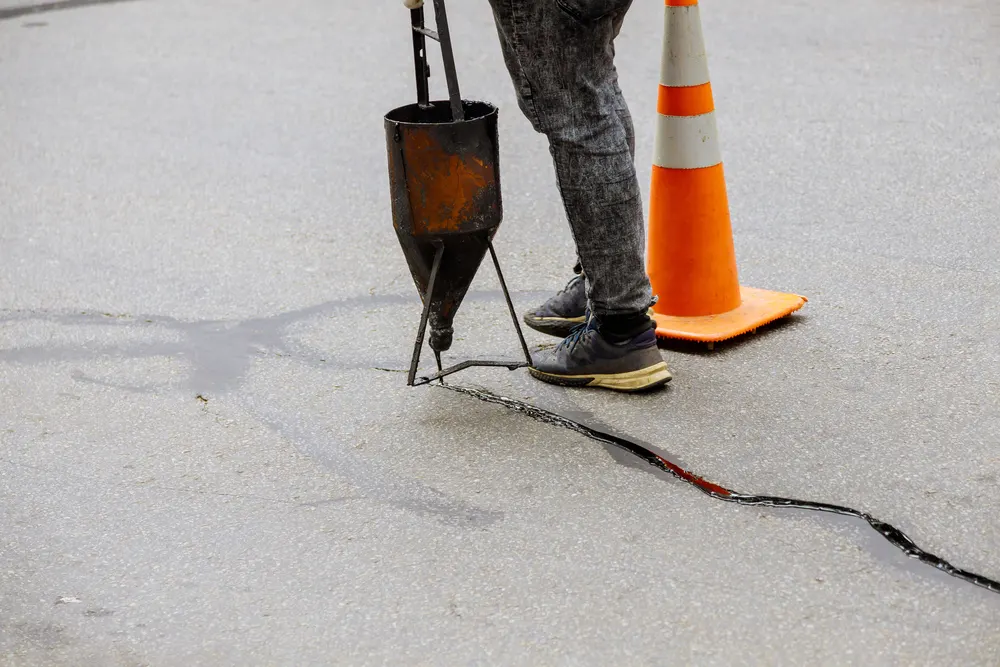
- Hot-Pour Sealant Application We apply commercial-grade rubberized hot-pour sealant directly into each crack using a melter applicator and wand. The sealant is heated to manufacturer specifications and applied at the correct fill level to create a watertight seal that sits flush with or slightly above the pavement surface.
- Overbanding (When Specified) On wider cracks or high-traffic areas, we apply a thin band of sealant over the top of the crack to provide additional surface coverage and protection against tire scuffing. This step adds durability in areas where traffic crosses the sealed crack repeatedly.
Why Aurora Property Owners Choose Shamblin Paving
With over 20 years of crack sealing and crack filling experience across Kane, DuPage, and Will counties, we have sealed thousands of linear feet of cracks on parking lots, drive aisles, roadways, and commercial properties throughout the western Chicago suburbs. We know which cracks need routing, which ones just need fill, and which ones are telling you the lot has bigger structural problems.
When you hire Shamblin Paving for asphalt crack sealing, you get:
- Licensed and insured commercial asphalt contractor
- Commercial-grade hot-pour rubberized sealant, not cheap cold-pour
- Crack routing for working cracks that need a lasting seal
- Honest assessment of whether cracks indicate deeper structural issues requiring patching or resurfacing
- Preventative maintenance scheduling including sealcoating to keep the lot protected between crack sealing cycles
- Transparent pricing with no hidden fees
Get a Free Crack Sealing Quote
Cracks spreading across your parking lot? Call Shamblin Paving at (630) 448-4411 or fill out our online form for a free, no-obligation estimate.